
THE CHALLENGE
Our society faces increasingly complex hazards and growing insecurity. Public authorities in charge of security and safety work tirelessly together to keep citizens safe, yet disasters do not respect national borders.
Police forces, fire brigades, rescue teams and civil protection services, among others, need to have access to seamless communication, real-time information exchange and be able to collaborate effectively across agencies and borders.
As first responders move across regions and countries, communication technology is not keeping up. Public authorities need to access and use their respective systems, application and data wherever they are, whenever they need with whomever they are assigned to work with. In order to achieve, this critical communication infrastructures must guarantee: reliable, secure and efficient transmission of critical information to support first responders in responding, coordinating and cooperating to address crisis situation in a timely and efficient manner.
Failures in these infrastructures can lead to dire consequences. Current national technologies across Member States does not meet today’s communication needs as these legacy technologies are only able to support voice and short communication which does not include videos and rich data.
In addition, only a few Member States have established interconnected and interoperable systems for cross-border communication. This means that when crossing a Member State border, public authorities need to find ad hoc solutions to be able to respond to a crisis situation, often having to work in sub-optimal conditions. Geopolitical boundaries should not limit cooperation when cross-border and pan-European operations can keep society safer.This is where the European Critical Communication System (EUCCS) steps in.
THE EUCCS CONCEPT OF OPERATIONS
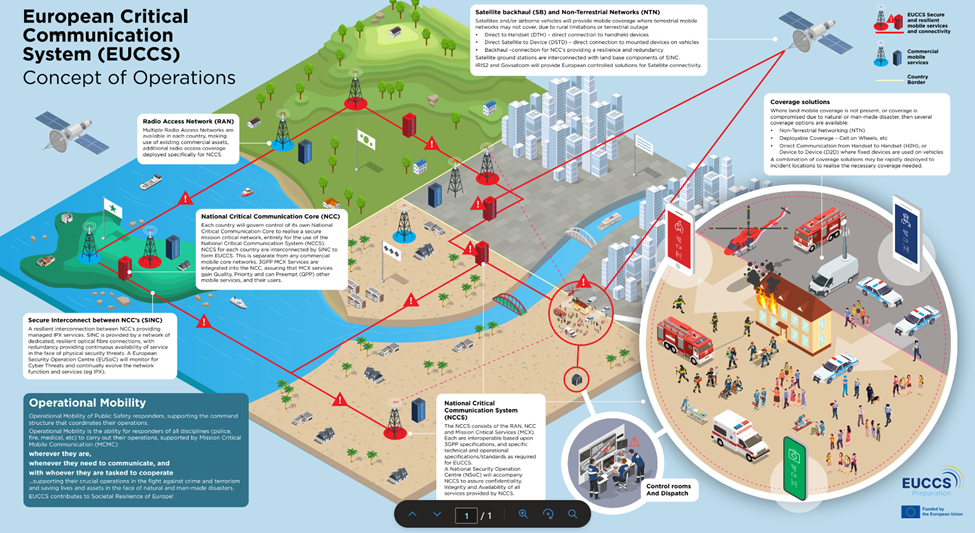
THE EUCCS (The European Commission Initiative)
In order to address the challenge faced by the public authorities in charge of security and safety, in the past years the need for a pan-European solution started gaining traction. Past projects funded by the EU security research programme laid the groundwork that would lead towards the conception of a pan-European system of systems.
In July 2024, the European Commission announced in the Political Guidelines for the next European Commission 2024-2029, its commitment to establish a new, state-of-the-art broadband-based European Critical Communication System (EUCCS)
The European Commission Directorate-General for Migration and Home Affairs (DG HOME), together with experts from EU Member States, are leading the establishment of the EUCCS. Through coordinated European action, EUCCS aims to provide a trusted, interoperable communication environment that supports responders during national, cross-border, and pan-European operations.The EUCCS shall enable the public authorities in charge of security and safety to use their broadband devised and systems to communicate an exchange data in and with any other Member States for cross-border and multi-national mission in real-time, 24/7 while using the same operational environment – including their usual devices, applications authentication methods and communication services – on which they rely daily in their Member States. It shall allow them to carry out their operations wherever they are, whenever they need to and in cooperation with whomever they are are assigned to work with.
EUCCS PREPARATION (The Programme)
EUCCS Preparation is working to support the establishment of EUCCS which will develop a pan-European mobile broadband system that enhances the communication and coordination of public authorities in charge of safety and security during crises and disasters by 2030.
EUCCS Preparation is providing the support needed to prepare the technology and procedures, and in the future, the application eco-system. Experts from most EU members states and Schengen associated countries are developing interconnected national testbeds to further explore and de-risk the technologies that will make EUCCS possible. With a collaborative approach and innovative communication solutions, EUCCS Prep is preparing for a reliable and resilient system that will improve the safety and security of citizens across Europe.
EUCCS Preparation will trial Mission Critical mobile technology and procedures. DG Home have created a Mission Critical Communication Expert Group (MCCG) to work towards preparing legislation that will be needed at the European level to support establishment of EUCCS. Experts from ALL EU member states and Schengen associated countries are involved. EUCCS Preparation will work alongside the MCCG to advise on technical matters.
Active responders will use EUCCS Preparation to trial existing new Operational Procedures for pan-EU collaboration. Responders will consider new ways of working when they are tasked to respond internationally.
EUCCS: A COMMISSION PRIORITY
Political Guidelines (2024–2029)
In her 2024 political guidelines, President Ursula von der Leyen emphasized the creation of a European Critical Communication System to support civil protection and public security across borders. The initiative was mentioned as a core pillar of the strategic vision for the EU during her second term as president of the European Commission.
The Mission Letter (2024)
In September 2024, European Commission President Ursula von der Leyen addressed a mission letter to the newly appointed Commissioner for Internal Affairs and Migration, Magnus Brunner. The mission letter outlined how Brunner’s mission will support the key pillars of the European political agenda for 2024-2029. With the EU’s security landscape constantly evolving, the Commissioner was tasked with shaping and updating EU legislation, policies, and operational responses to enhance Europe’s internal security. In addition, President von der Leyen highlighted the European Critical Communication System (EUCCS) as a crucial initiative to enhance the security of the European Union.
ProtectEU (2025)
In April 2025, the EUCCS was identified as one of the key actions of ProtectEU, the new European Internal Security Strategy, 2025-2027. The document complements the EU Preparedness Union Strategy launched in March 2025. The Preparedness Strategy elicits an all-around approach to predicting complex crises and enhancing the EU’s preventive and responsive measures. It action Plan aims to foster a whole-of-society response to preparedness by emphasizing inter and cross-sectoral coordination, with the ultimate goal of building resilience and preparing for future challenges.
Mission Critical Expert Group
The European Commission’s DG HOME has established a Mission Critical Expert Group, involving experts from EU and Schengen Member States, to assist in the preparation of EUCCS legislation and policy initiatives.